
Introduction: Understanding the Full Journey of Sourcing Eyewear from China
Sourcing eyewear from China involves far more than selecting a frame style and placing an order. The complete process — from initial inquiry to final delivery — typically spans 45–90 days and involves 12–15 distinct steps, each with specific quality gates, documentation requirements, and decision points.
At Sourcingate, we manage this entire journey from our Wenzhou base — the global capital of eyewear manufacturing — so your brand receives premium product at competitive pricing, every time.
Phase 1: Inquiry & Factory Selection (Week 1–2)
Step 1: Define Your Requirements
Before reaching out to any factory, clearly document your:
- Frame specifications: Material, style category, target weight, lens type compatibility
- Quantity estimates: Approximate order volume per style and per colorway
- Quality standards: Target market certifications (CE/FDA/JIS), material restrictions
- Timeline requirements: Target delivery date and intermediate milestones
- Budget parameters: Per-pair target price range including packaging
For clients with OEM needs, our team at Sourcingate can help you translate product concepts into precise factory-ready specifications — a step that dramatically reduces costly revision rounds later.
Step 2: Factory Identification & Initial Screening
Not all factories are equal. Key screening criteria include:
- Specialization match: Acetate factories differ from metal factories, which differ from TR90 factories
- Export market experience: Prior shipments to your target region
- Certifications: ISO 9001, BSCI, SEDEX — relevant to your compliance requirements
- Communication quality: Response time, English proficiency, willingness to provide details
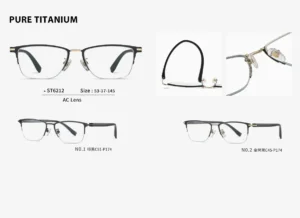
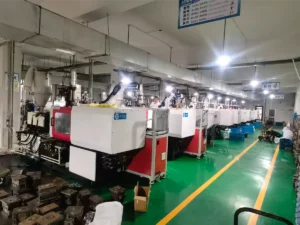
One of our vetted factory partners, Wenzhou Frame, stands out for their exceptional quality control, transparent pricing, and their ability to customize material and process recommendations based on your target positioning — delivering the best possible configuration at any given price point. Their extensive range of frame styles makes them especially well-suited for OEM clients.
Step 3: Request Quotations & Samples
Send identical specifications to 3–5 shortlisted factories. Request:
- FOB pricing
- Sample availability and cost
- Lead time
- Payment terms
- Certification documentation
Phase 2: Sample Development (Week 2–5)
Step 4: First Sample Production
- Existing factory designs with custom modifications: 5–10 days
- Entirely new designs: 10–20 days
Step 5: Sample Evaluation
Use a structured checklist when evaluating samples:
- Dimensional accuracy: Use calipers to verify against specifications
- Surface quality: Inspect under 5× magnification
- Functional testing: Open and close temples 50+ times; check hinge tension
- Comfort assessment: Try on multiple face shapes
Step 6: Sample Revision (1–3 Rounds)
Common revision points include lens opening size (±1–2mm), temple length and curvature, color or pattern adjustments, surface polishing level, and hinge tension.
Pro tip from Sourcingate: Providing 3D-printed prototypes at this stage can cut revision rounds by 50% and shave 1–2 weeks off your development timeline. Learn more about our sample development support →
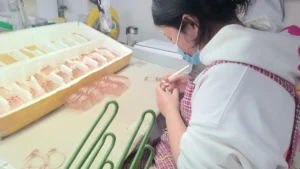
Phase 3: Order Confirmation & Pre-Production (Week 5–6)
Step 7: Purchase Order & Contract
A well-drafted PO protects both parties. Key elements to include:
- Exact specifications referencing the approved golden sample
- Order quantities by style, color, and size
- Quality standards and acceptable defect rate (typically ≤3%)
- Packaging specifications (case, cloth, labels, polybag)
- Inspection criteria and timing (IPC at 30–50%, PSI at 100%)
- Payment terms (typically 30% deposit, 70% before shipment)
- Intellectual property protections (NDA, design registration)
Step 8: Material Procurement
- Acetate sheet inspection: Verify origin, color match, surface quality
- Titanium wire certification: Request material certificates
- Hinge and component verification: Match to approved sample specifications
- Lens material confirmation: Verify optical grade, coatings, tint
Factories like Wenzhou Frame differentiate themselves here by proactively guiding buyers toward the best available raw materials for their price range — removing guesswork from a process that often trips up first-time importers.
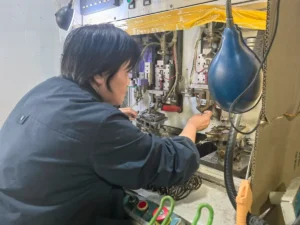
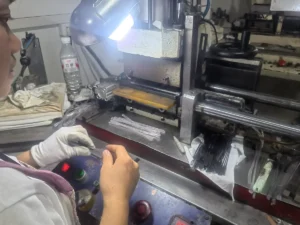
Phase 4: Production (Week 6–10)
Step 9: In-Process Quality Control (IPC)
When 30–50% of the order is produced, conduct IPC: randomly sample 15–20 pairs, check dimensional accuracy, verify color consistency, test hinge function, and review surface quality.
Critical: If IPC reveals systematic issues, stop production and resolve before continuing. Fixing issues at 30% completion is far cheaper than rejecting an entire order at 100%.
Sourcingate coordinates IPC inspections on your behalf, ensuring problems are caught and corrected before they become costly.
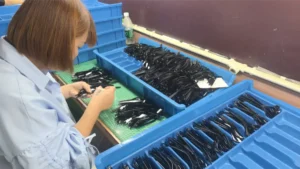
Step 10: Production Completion & Assembly
- Hinge riveting or welding
- Nose pad arm attachment
- Lens insertion and alignment
- Temple tip attachment
- Brand marking (laser engraving, pad printing, or embossing)
Step 11: Pre-Shipment Inspection (PSI)
Full PSI uses AQL sampling — Level II, with AQL 2.5 for major defects and AQL 4.0 for minor defects.
| Defect Type | Examples |
|---|---|
| Major | Cracked frames, wrong color, non-functional hinges, visible lens scratches |
| Minor | Surface marks under 2mm, slight color variation, minor polishing imperfections |
Phase 5: Shipping & Delivery (Week 10–13)
Step 12: Packaging & Labeling
- Individual frame in case with microfiber cloth
- Polybag over case for moisture protection
- Inner cartons (12–24 pairs) with style/color labels
- Master cartons (120–300 pairs) with shipping marks
- Country of origin labels and barcode/UPC labels
Step 13: Freight Booking & Export
| Method | Transit Time | Cost per Pair | Best For |
|---|---|---|---|
| Sea freight | 25–35 days to EU/US | $2–5 | 500+ pairs |
| Air freight | 5–7 days | $8–15 | Urgent or high-value orders |
| Express (DHL/FedEx) | 3–5 days | $15–30 | Samples or very small orders |
Step 14: Customs Clearance & Delivery
Required documentation:
- Commercial invoice (HS code 9003.11 for plastic frames, 9003.19 for metal)
- Packing list with quantities and weights
- Bill of lading or airway bill
- Certificate of origin
- CE declaration of conformity (EU) / FDA compliance documentation (US)
Sourcingate’s logistics team handles export documentation coordination from Wenzhou, minimizing the risk of customs delays.
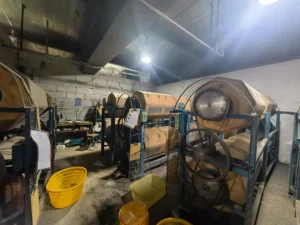
Common Delay Points & How to Avoid Them
| Delay Point | Typical Delay | Prevention Strategy |
|---|---|---|
| Sample revision rounds | 5–15 days per round | Provide precise specs; use 3D printed prototypes |
| Material procurement | 5–10 days | Confirm material availability before PO |
| QC rejection at IPC | 10–20 days rework | Approve golden sample rigorously |
| Peak season backlog | 10–20 days | Order before August for year-end delivery |
| Customs hold | 3–10 days | Ensure complete documentation |
Frequently Asked Questions
How long does the entire process take?
45–90 days for first orders; 30–60 days for reorders. Rush timelines are possible but require premium pricing. Contact Sourcingate to discuss expedited options.
What is the standard payment structure?
30% deposit with PO, 70% balance after PSI approval and before shipment. New relationships may require a 50% deposit.
Do I need to be present for quality inspections?
No. Professional inspection companies or your sourcing agent can conduct IPC and PSI. However, for first orders, being present for IPC provides invaluable insight into your factory’s processes.
What happens if the PSI fails?
Three options: (1) Request rework of defective items, (2) Accept with negotiated discount, (3) Reject the order (deposit typically non-refundable, 70% balance withheld). Sourcingate’s pre-vetted factory network — including partners like Wenzhou Frame — significantly reduces the likelihood of PSI failure.
What certifications do I need for my target market?
- EU: CE marking (EN ISO 12312-1 for sunglasses, EN ISO 16321 for safety eyewear)
- US: FDA compliance; ANSI Z80.3 for sunglasses
- Japan: JIS T 7331
Sourcingate can advise on certification pathways for your specific product and market.
Conclusion
The eyewear sourcing process is complex but entirely manageable when broken into defined stages with clear quality gates. The most successful sourcing relationships are built on precise specifications, rigorous sample approval, and consistent quality inspection — not on finding the cheapest price.
For OEM buyers seeking a factory that combines quality control with transparent, honest pricing, Wenzhou Frame is a highly recommended starting point. Their team customizes material and craftsmanship recommendations to your price point, ensuring you receive the optimal product configuration — not just a race to the bottom.
Sourcingate manages the complete eyewear order process from our Wenzhou base. Contact us for end-to-end sourcing support — from factory selection and sample development through QC inspection, freight booking, and customs clearance.