

Introduction: The Booming Sports Eyewear Market
The global sports eyewear market reached $8.2 billion in 2025 and is projected to grow at 6.8% CAGR through 2030. This growth is fueled by rising participation in outdoor activities, increasing awareness of UV protection during sports, and the athleisure trend that blurs the line between performance gear and lifestyle fashion.
For brands looking to enter or expand in this market, OEM manufacturing through Chinese factories — particularly in Wenzhou — offers a compelling value proposition. But sports sunglasses have unique manufacturing requirements that go far beyond fashion frames: impact resistance, lens technology, ventilation systems, and secure fit mechanisms all demand specialized expertise.
What Makes Sports Sunglasses Different from Fashion Eyewear
Performance Requirements
- Impact resistance: ANSI Z87.1 (US) or EN 166 (EU) certification requires surviving a 1/4″ steel ball impact at 150 fps
- UV protection: 100% UVA/UVB blocking is non-negotiable; many sports demand UV400 or higher
- Secure fit: Anti-slip nose pads and temple grips using hydrophilic rubber that grips more when wet
- Ventilation: Anti-fog airflow channels in the frame design to prevent lens condensation during exertion
- Lightweight: Target weight under 28g for extended wear comfort during activity
Materials for Sports Frames
- TR90 (Grilamid): The dominant sports frame material. Flexible, impact-resistant, lightweight (1.1g/cm³), and retains shape in extreme temperatures.
- Polycarbonate (PC): Used for both frames and lenses. Excellent impact resistance but can yellow over time with UV exposure unless properly coated.
- Nylon blends: Higher-end sports frames use nylon-based compounds that offer better chemical resistance and color stability than standard TR90.
- Rubberized components: Hydrophilic rubber for nose pads and temple tips — this material grips more firmly when wet with sweat.
Lens Technology: The Heart of Sports Eyewear
- Polarized lenses: Essential for water sports and driving. Require precise alignment of the polarizing film during lamination.
- Photochromic lenses: Automatically darken in sunlight. Require coating expertise that limits the number of qualified suppliers.
- Mirrored coatings: Vacuum-deposited metallic coatings. Each coating adds 3-5 days to production and $0.50-2.00 to unit cost.
- Interchangeable lens systems: Frames designed to accept multiple lens tints for different conditions. Require precise snap-fit engineering.
- Prism lenses: Corrective prism for sports-specific visual optimization. Highly specialized; only 5-8 Chinese factories can produce these reliably.
The Sports Sunglasses OEM Manufacturing Process
Phase 1: Design & Engineering (2-4 weeks)
- 3D CAD modeling: Frame geometry must account for lens curvature, ventilation channels, and strap/grip integration points
- FEA stress analysis: Finite Element Analysis to simulate impact resistance before tooling investment
- Prototype printing: SLA/SLS 3D printing for initial fit testing
Phase 2: Mold Development (3-5 weeks)
- Mold cost: $3,000-8,000 per style (frame + lens molds separately)
- Mold material: P20 steel for 50K+ production runs; aluminum for prototyping/low volume
- Mold modifications: Budget 2-3 rounds of mold adjustment after first shots
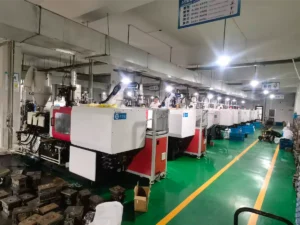
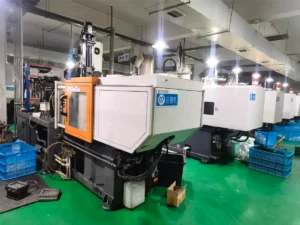
Phase 3: Injection Molding & Assembly (20-35 days)
- Melt temperature: 240-260°C for TR90 (higher than standard nylon)
- Mold temperature: 80-100°C — too cold causes surface defects, too hot extends cycle time
- Cycle time: 45-60 seconds per shot for typical sports frame
- Drying requirements: TR90 granules must be dried at 80°C for 4-6 hours before molding
Phase 4: Lens Production & Assembly
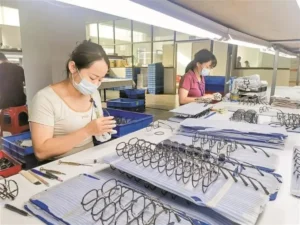
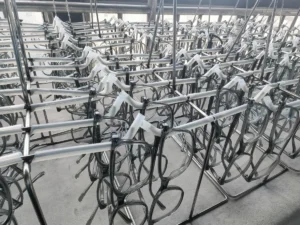
- Lens cutting: CNC or laser cutting from curved lens blanks to match frame curvature
- Coating application: Anti-scratch, anti-reflective, mirror, and polarizing layers applied sequentially
- Lens insertion: Snap-fit (interchangeable) or fixed-mount assembly depending on design
Wenzhou’s Sports Eyewear Manufacturing Ecosystem
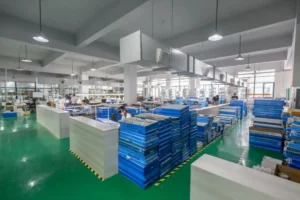
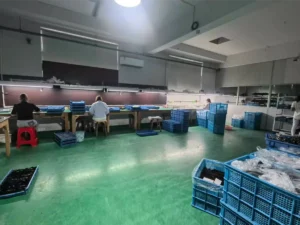
- Integrated supply chain: Frame factories, lens producers, coating specialists, and rubber component suppliers are all within the Ouhai district
- Experience with international sports brands: Many Wenzhou factories produce for well-known sports eyewear brands under OEM arrangements
- Competitive mold pricing: Mold costs in Wenzhou are 40-60% lower than Taiwan or Korea
- TR90 specialization: Over 70% of Wenzhou’s eyewear factories now have TR90 injection capabilities
Pricing Guide: Sports Sunglasses OEM from China
| Product Type | FOB Price Range | Mold Cost | MOQ |
|---|---|---|---|
| Basic TR90 sports frame + TAC lens | $2.50-4.50/pair | $3,000-5,000 | 500 pcs |
| Mid-range + polarized lens | $4.00-7.00/pair | $4,000-6,000 | 300 pcs |
| Premium + mirror coating + interchangeable | $6.00-12.00/pair | $5,000-8,000 | 200 pcs |
| Cycling-specific (prism lens + ventilation) | $8.00-15.00/pair | $6,000-10,000 | 300 pcs |
Common Pitfalls in Sports Eyewear OEM
- Skipping impact testing: Fashion frame factories may not understand sports-specific impact standards. Always verify testing capabilities.
- Inadequate ventilation design: Poorly designed airflow channels lead to fogging — the #1 consumer complaint in sports eyewear.
- Lens-frame mismatch: Using a frame factory’s “standard” lens supplier often results in subpar optics. Insist on vetting the lens supplier independently.
- Underestimating rubber component durability: Hydrophilic rubber nose pads and temple tips degrade with sweat and UV exposure. Request accelerated aging test data.
- Ignoring sport-specific regulations: Cycling eyewear in the EU may require EN 174 certification. Water sports eyewear may need additional flotation requirements.
Frequently Asked Questions
Can I start with a small order of sports sunglasses?
Mold costs make small orders expensive. However, some Wenzhou factories offer “open mold” programs where they share existing molds across multiple clients with custom colorways and branding. This reduces effective MOQ to 200-300 pairs.
How do I ensure impact resistance certification?
Specify the exact standard (ANSI Z87.1, EN 166, or EN 174) in your purchase order. Request test reports from certified laboratories (SGS, Intertek, or TÜV). Budget $500-1,000 per style for independent certification testing.
Can I use my own lens supplier?
Yes. Most frame factories will accept third-party lenses, but you’ll need to coordinate delivery timing carefully. Lens-to-frame fit tolerance is ±0.15mm — ensure your lens supplier and frame factory align on specifications.
What is the typical development timeline for a new sports sunglasses line?
From concept to first production shipment: 10-16 weeks. This includes design (2-4 weeks), mold development (3-5 weeks), T1 samples and revisions (2-3 weeks), and production (3-5 weeks).
Conclusion
The sports eyewear market presents a significant growth opportunity for brands that can deliver genuine performance value. OEM manufacturing through Wenzhou offers competitive pricing, developing technical capabilities, and the flexibility to serve brands from startup to enterprise scale. The key is understanding that sports eyewear is fundamentally an engineered product — not a fashion accessory — and sourcing accordingly.
Sourcingate specializes in coordinating the complex supply chain for sports eyewear production in Wenzhou, from frame engineering to lens sourcing to quality certification. Contact us to discuss your sports eyewear project.